
When you or a loved one enters a 90-day rehab program, it is natural to feel a mix of relief and anxiety. At Clay Crossing, we understand that addiction doesn’t just affect the individual; it impacts the entire family unit. Our 90-day rehab program in Maud, Oklahoma is designed to provide the time and space necessary for deep, sustainable healing.
A 90-day rehab program is a long-term residential treatment model giving patients a structured environment to overcome substance use disorders. It’s three full months of clinical support, giving the brain time to heal and practice new coping skills before returning to daily life.
Key Takeaways
- Duration Matters: Research shows that longer treatment stays, specifically 90 days, are often associated with better long-term sobriety outcomes.
- Phased Approach: Treatment moves from medical stabilization (detox) to intensive therapy and, finally, comprehensive aftercare planning.
- Family Involvement: Families are encouraged to participate through therapy and scheduled visits to heal the relationships strained by addiction.
- Skill Building: The extended timeframe allows for “real-world” practice of sobriety skills in a safe, controlled environment.
Why 90 Days? Understanding the Case for Longer Treatment
The “30-day” model is often what we see in movies, but clinical research frequently points toward a longer timeline for those with severe or chronic addiction.
What the Research Generally Shows About Treatment Duration
According to the National Institute on Drug Abuse (NIDA), individuals who remain in treatment for at least 90 days have significantly better outcomes than those who stay for shorter durations. Addiction physically changes the brain’s chemistry and “wiring.” It often takes at least 30 days just for the brain to clear the fog of withdrawal and begin functioning at a baseline level.
By extending the stay to three months, the individual isn’t just “staying sober”… they are rebuilding their identity. This timeframe provides enough room to address the underlying trauma or mental health issues that often fuel substance use in the first place.
Comparing Levels of Care
Understanding where a 90-day residential program fits compared to other options is essential for making an informed choice.
| Treatment Level | Duration | Intensity | Best For |
| Medical Detox | 5–10 Days | High (Medical Focus) | Safe withdrawal management |
| Standard Inpatient | 28–30 Days | High (Clinical Focus) | Short-term stabilization |
| 90-Day Residential | 90 Days | High (Holistic Focus) | Chronic addiction & co-occurring disorders |
| Partial Hospitalization (PHP) | Varies | Medium (Days Only) | Transitioning from inpatient to home |
| Intensive Outpatient (IOP) | Varies | Low to Medium | Individuals with strong home support |
What Happens During a 90-Day Program
A 90-day stay is rarely a flat line of the same activities. Instead, it is a journey through three distinct phases.
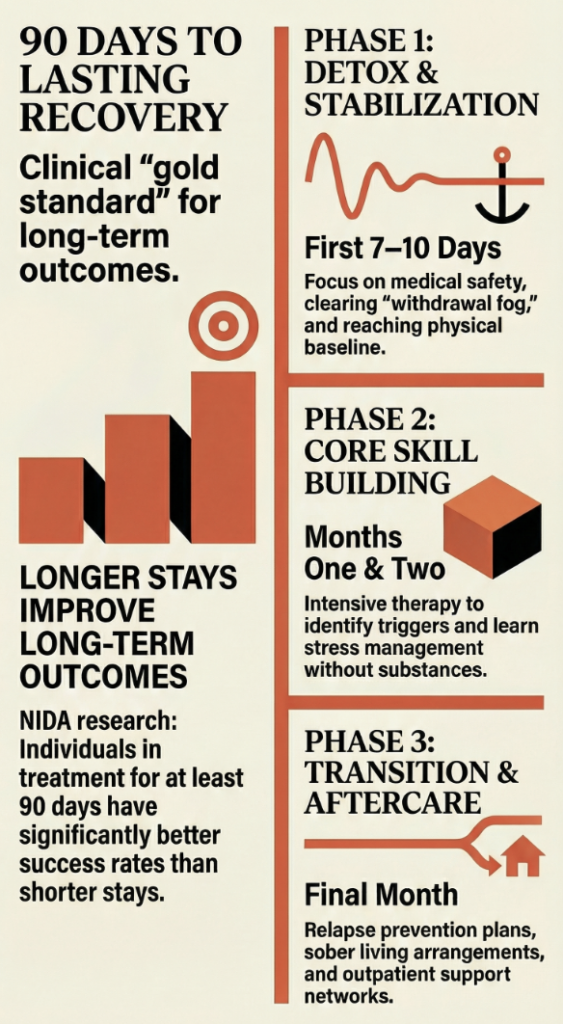
Phase 1: Detox and Stabilization
The first week to ten days focus almost entirely on physical safety. Medical professionals monitor the individual as the substances leave their system. This is often the most difficult time for families, as communication may be limited while your loved one focuses on physical recovery. The goal here is to manage withdrawal symptoms comfortably and ensure the individual is medically stable enough to begin therapy.
Phase 2: Core Treatment and Skill Building
This is the “heavy lifting” portion of the program, usually spanning months one and two. Your loved one will participate in:
- Individual Therapy: Working one-on-one with a counselor to identify triggers.
- Group Therapy: Building community and learning from peers with similar struggles.
- Behavioral Therapies: Using methods like Cognitive Behavioral Therapy (CBT) to change negative thought patterns.
- Life Skills: Learning how to manage stress, finances, and relationships without turning to substances.
Phase 3: Transition Planning and Aftercare
In the final month, the focus shifts toward the future. A 90-day program is only the beginning of a lifelong journey. During this phase, staff work with the individual to create a “relapse prevention plan.” This includes finding local support groups, setting up outpatient therapy, and sometimes arranging for “sober living” housing to bridge the gap between the facility and home.
How Families Fit Into the Process
One of the biggest fears families have is that their loved one will “disappear” for three months. In reality, healthy family involvement is a cornerstone of our philosophy at Clay Crossing.
Visitation, Communication, and Boundaries
Initially, there may be a “blackout” period where phone calls are restricted to help the individual focus. As they progress, regular phone calls and scheduled visitations begin. It is important to remember that these boundaries aren’t “punishment”—they are designed to protect the therapeutic environment and help both you and your loved one develop a healthier relationship dynamic.
Family Therapy and Involvement Opportunities
Addiction often creates patterns of codependency or resentment within a family. We offer family therapy sessions where you can speak openly in a guided, safe environment. These sessions help you understand the disease of addiction, while your loved one learns how their actions have impacted the people they love most.
A Note to Families: If you have questions about what involvement looks like during treatment or how to handle communication, our team is available for a confidential conversation. We are here to support you just as much as your loved one.
Preparing as a Family: What to Do Before Day One
Preparation can help ease the “pre-rehab” jitters for everyone involved.
A Checklist for Families Getting Ready
- [ ] Gather Medical Records: Have a list of current medications and previous health history ready.
- [ ] Handle Logistics: Ensure bills are on autopay and childcare or pet care is arranged for the 90-day duration.
- [ ] Pack According to Guidelines: Facilities have strict rules on what can be brought in (e.g., no products containing alcohol, specific clothing requirements).
- [ ] Communicate with Employers: Help your loved one understand their rights under the Family and Medical Leave Act (FMLA).
- [ ] Set Your Own Support: Find an Al-Anon or Nar-Anon meeting for yourself so you have a support system while they are away.
Feeling overwhelmed by the logistics? We put together a short guide to help you feel more prepared. It includes a comprehensive packing list and a “Questions to Ask” worksheet for your facility tour. It’s free, and it’s yours whenever you’re ready.
Finding a 90-Day Program in Your Area
When searching for “90-day treatment programs near me,” it’s important to look beyond just the location. You want a facility that feels like a community.
What to Look For When Choosing a Facility
- Accreditation: Ensure the facility is licensed and accredited by organizations like the Joint Commission or CARF.
- Staff-to-Patient Ratio: Smaller ratios often mean more personalized care.
- Specialized Tracks: Look for programs that handle specific needs, such as dual diagnosis or gender-specific care.
- Aftercare Focus: A good program starts planning for the day of discharge on day one.
How Clay Crossing Supports Families
Located in our tranquil regional setting, Clay Crossing serves as a sanctuary for Oklahoma City and surrounding areas. We believe that long-term recovery is most successful when it happens in an environment that feels less like a hospital and more like a path to a new life. Our approach to family involvement is authentic and frequent; we don’t just “allow” family. We invite you to be part of the solution. Our staff lives and works in this community, and we are dedicated to helping our neighbors find their way back to health.
Common Questions Families Ask Before Day One
1. What actually happens during a 90-day rehab program? A 90-day program involves a structured daily schedule of individual therapy, group counseling, and wellness activities. It is a three-phase journey moving from medical detox to intensive psychological work and, finally, to real-world transition planning.
2. Is 90-day rehab more effective than 30-day programs? Generally, yes, especially for those with long-term addictions. Studies from organizations like SAMHSA suggest that longer stays provide the time needed for brain chemistry to stabilize and for new habits to take root, reducing the risk of early relapse.
3. Can family members visit during a 90-day treatment program? Yes, most programs encourage family visitation after an initial stabilization period. At Clay Crossing, we schedule specific family days and therapy sessions to ensure you stay connected throughout the process.
4. How do I help a loved one prepare for 90 days away from home? The best way to help is to remain supportive but firm about the necessity of treatment. Help them handle their “real world” responsibilities (like bills or pets) so they can enter treatment with a clear mind.
5. What does a typical day look like in a 90-day residential program? Days are highly structured, usually starting with breakfast and a morning reflection, followed by several hours of group or individual therapy. Afternoons may include specialized workshops or exercise, while evenings often focus on 12-step meetings or peer support.
6. Will my loved one’s job or insurance be protected during a 90-day stay? In many cases, yes. The Family and Medical Leave Act (FMLA) often protects the jobs of those seeking treatment for a serious health condition like addiction. Additionally, many insurance providers cover residential treatment, though the level of coverage varies.
7. What happens after the 90 days are over? Recovery continues through an “aftercare” plan. This might include living in a sober house, attending intensive outpatient programming (IOP), or continuing with weekly individual therapy and support groups.
Taking the First Step Together
The path to recovery is a long one, but you don’t have to walk it alone. A 90-day program offers the comprehensive support your loved one needs to build a foundation that lasts.
If you are ready to learn more or simply want to see if a 90-day program is the right level of care for your family’s unique situation, we are here to help. Let’s take this first step together.
Contact Clay Crossing today for a confidential consultation.
Safety Resources
- SAMHSA National Helpline: 1-800-662-HELP (4357)
- National Suicide Prevention Lifeline: 988
- Crisis Text Line: Text HOME to 741741